
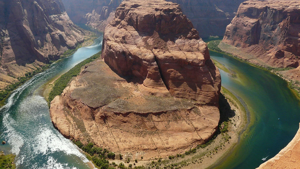
Arizona’s Central Arizona Project joins Colorado River lawsuit
The canal system that provides 36% of all water in Arizona is officially joining the state’s litigation against the Trump administration over Colorado River water cuts.
Officials representing the 336-mile-long Central Arizona Project, which runs south toward Phoenix and Tucson from its headwaters in Lake Havasu, this week joined the litigation against the federal government that was initially brought forth by Nevada in August. Earlier month, Arizona announced it was joining the lawsuit.
In CAP’s Motion to Intervene, agency officials say the Department of the Interior’s proposed 10-year river plan, which includes cuts in water usage, could drastically alter the canal’s future.
“That water supply could be drastically reduced — in some conditions reduced to zero — based on the agency actions challenged in this case and the outcomes of the legal challenges to those agency actions,” CAP’s motion to intervene says. “[Central Arizona Water Conservation District] seeks leave to intervene to protect its interest and to ensure they are considered. Those interests will be impaired without CAWCD’s participation.”
Steep cuts
Under the proposed Colorado River plan that was released earlier this year by the U.S. Bureau of Reclamation, the three Lower Basin states – Arizona, California and Nevada – would face cuts of up to 40%, river water wise. But the Upper Basin states of Colorado, New Mexico, Utah and Wyoming would not have to cut back their usage. The bureau is part of the Department of the Interior.
The Arizona canal system features prominently in the state’s cutbacks. CAP’s water allotment could be cut in half as soon as next year if the drought that’s plagued the American Southwest doesn’t subside.
The state’s chief Colorado River negotiator is Tom Buschatzke, who was appointed as the head of the Arizona Department of Water Resources by former Gov. Doug Ducey, a Republican, in 2015.
Buschatzke told The Center Square in an email that CAP’s decision to join the suit stems from protecting its long-term water usage interests, serving its customers across the state in the long run.
“The Central Arizona Project plays a unique role in supplying vital water supplies from the Colorado River to urban communities, tribes, agriculture and other water users in central and southcentral Arizona,” Buschatzke told The Center Square. “We recognize they are taking this action in the best interests of their water users.”
Sharon Megdal, director of the University of Arizona’s Water Resources Research Center, told The Center Square that CAP’s decision isn’t much of a surprise.
Megdal said she believes the legal action by the state and CAP is another avenue for Arizona to take in addressing its short-and-long term water future, with all parties doing whatever they can to shore up as much of the dwindling resource as possible.
“We’re dealing with a tremendously uncertain situation, and so the two words that I’m saying in a lot of the talks are ‘uncertainty’ and then ‘preparedness,’ ” Megdal told The Center Square on Thursday. “Arizona is trying to do all it can to prepare, and that’s the bigger picture. Augmentation, more conservation, all these things, and I keep saying that everybody’s working on it.
“But the point is that I do believe that, especially from the perspective of being in Arizona, that preparedness for different future scenarios is extremely important because of the uncertainty,” she added.
Uncertain future
Central Arizona Project General Manager Brenda Burman told Phoenix NPR affiliate KJZZ that the agency’s decision to join the lawsuit stemmed from the unequal cuts that were being asked of the seven states that signed the 1922 Colorado River Compact.
“CAP has spent years negotiating with the federal government to avoid the need for this litigation,” Burman said. “Our goal has been to stay out of court, but not at the expense of defending our rights and the laws governing the Colorado River. The law should be upheld.”
Megdal said one potential answer could be for the four Upper Basin users to agree to cut back on their river allotments, easing the one-sided nature of the DOI’s updated plan.
“What’s going to lead them to come to the table and agree on something is not the current Record of Decision as I see it,” Megdal said. “But maybe if the parties can come together now that a lawsuit’s filed, they can try to avoid extended proceedings and work on some sort of settlement.”
During her interview with radio station KJZZ, Burman said she sees litigation as a solution.
“The federal government can’t ignore the obligations and watch the compact be breached without any plan to bring it back into compliance and at the same time manufacture a drought for the Lower Basin,” Burman said. “Particularly, they can’t put that burden all on CAP’s shoulders.”





Partly Sunny then Scattered Rain Showers
