
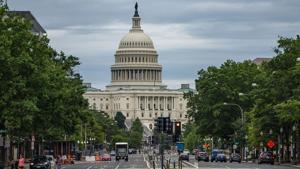
Control of U.S. Senate at stake as polls start closing
Control of the U.S. Senate hangs in the balance Tuesday as voters across the country cast ballots in midterm elections that could reshape the balance of power in Washington.
Republicans currently hold a 53-47 majority in the Senate, leaving Democrats needing a net gain of four seats to take control of the chamber. While election forecasters widely expect Democrats to regain control of the House, the battle for the Senate remains more competitive.
Thirty-five Senate seats are on the ballot, with Republicans defending 22 regular seats and two special-election seats.
Election forecasters have increasingly revised their assessments of Senate control in Democrats’ favor. Decision Desk HQ’s final forecast gave Democrats a 65% chance of winning the chamber, projecting a 52-48 majority.
The nonpartisan Cook Political Report also moved several races toward Democrats in recent weeks, with six Republican-held seats classified as toss-ups in its final ratings.
Kansas, Iowa, Ohio, Alaska, Texas and Maine are among the most closely watched contests, with Cook Political Report rating all six as toss-ups. Decision Desk HQ also includes South Carolina among its competitive races.
Michigan was previously considered among the most competitive Senate races, but several election forecasters shifted their ratings toward Democrats in the weeks leading up to Election Day, with Cook Political Report moving the race from Toss Up to Lean Democrat on Monday.
The elections come amid a difficult political environment for Republicans, with President Donald Trump’s approval rating hovering near historic lows and voters expressing widespread dissatisfaction with the cost of living.
Just 32% of Americans approved of Trump’s job performance in a Reuters/Ipsos poll released Monday, while Democrats held an eight-percentage-point advantage over Republicans on the generic congressional ballot among registered voters.
Economic concerns have figured prominently in the campaign, particularly inflation, rising energy prices and the effects of tariffs and the war with Iran.
Campaign spending in the 2026 midterm elections is projected to approach a record $12 billion, according to OpenSecrets, a nonprofit organization that tracks money in politics.
Democratic candidates are expected to spend more than $2.2 billion, compared with $1.4 billion by Republicans, although Republican-aligned outside groups have outspent their Democratic counterparts by nearly $400 million.
Texas is among the most expensive contests, with more than $500 million spent by candidates and outside groups.
Early voting has reached record levels, with more than 57 million Americans casting ballots before Election Day, according to the University of Florida Election Lab.
Several competitive Senate states have reported particularly strong turnout, including Texas, where more than 7.7 million ballots were cast early. Democratic voters have historically been more likely than Republicans to cast their ballots early, although Republicans have increasingly encouraged their supporters to vote ahead of Election Day.
Most polls in the closely watched states close between 7 and 9 p.m. Eastern time, although voting continues until midnight Eastern in most of Alaska.
While election officials begin counting ballots Tuesday, Alaska’s ranked-choice voting system and the time needed to count outstanding absentee ballots could delay final results until late November.
Closely contested races elsewhere could also take additional time to resolve, particularly if outstanding absentee or provisional ballots could affect the outcome.






Rain Showers
